

The Birth Control Pill: The Documented Science They Don't Put on the Pamphlet
The birth control pill is prescribed to over 150 million women globally. It is widely considered safe, routine, and thoroughly understood. But if you bypass the mainstream consensus and read the actual peer reviewed pharmacology, psychiatry, and historical archives, a different record emerges. What follows is not conspiracy. It is the documented chemistry, the published clinical trials, and the verified financial history of the most widely prescribed drug in the world.
The Chemistry: Synthetic Steroids in the Birth Control Pill:
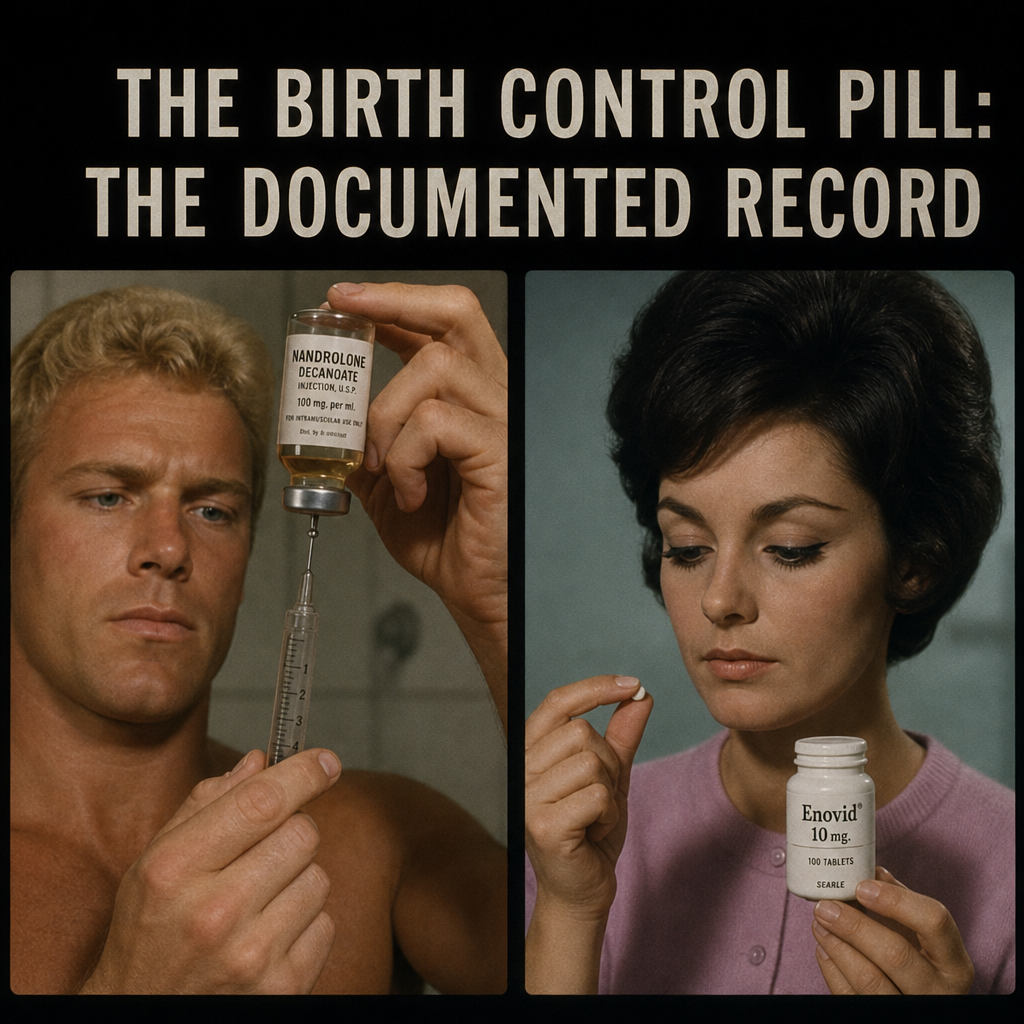
The birth control pill is classified pharmacologically as a contraceptive steroid. The two active compounds in a combined oral contraceptive are a synthetic estrogen and a progestin. Both are steroids. The most widely used progestin in birth control pills is levonorgestrel. Wikipedia's entry on levonorgestrel, sourced from peer-reviewed pharmacology literature, describes it as a synthetic estrane steroid and a derivative of testosterone. Its chemical synthesis was developed using nandrolone as a precursor compound.
Nandrolone is classified by the United States Drug Enforcement Administration as a Schedule III controlled substance under the Anabolic Steroids Control Act of 1990. It is one of the most tested-for performance-enhancing drugs in professional sport, with detection windows of up to eighteen months following a single injection. Athletes who test positive face suspension or lifetime bans depending on jurisdiction and history.
The National Center for Biotechnology Information confirms in its published article The Chemistry of the Pill that early progestins used in combined oral contraceptives, including norethindrone and levonorgestrel, were primarily derived from testosterone, an androgen. The Global Library of Women's Medicine classifies these compounds specifically as contraceptive steroids.
What this means: the active ingredient in most birth control pills belongs to the same molecular family as the performance-enhancing steroids that end athletic careers. The compounds differ in their specific modifications and intended effects. The classification is the same.
THE ATTRACTION RESEARCH - PROCEEDINGS OF THE ROYAL SOCIETY B, 2008
In August 2008, Craig Roberts and colleagues at the University of Liverpool and the University of Newcastle published a study in the Proceedings of the Royal Society B. The title is MHC-correlated odour preferences in humans and the use of oral contraceptives. The full citation is Roberts SC, Gosling LM, Carter V, Petrie M. Proceedings of the Royal Society B 275:2715-2722, 2008.
The study examined the role of the major histocompatibility complex, known as the MHC, in human partner selection. The MHC is a group of genes that codes for immune system function. Research across multiple species shows that individuals tend to be attracted to partners whose MHC genes differ from their own. The biological basis is that children born to MHC-dissimilar parents inherit more varied immune profiles and are better equipped to fight disease. The mechanism through which humans detect this compatibility is primarily olfactory, carried in body odour.
The Roberts 2008 study found that women using hormonal contraceptives showed a measurable shift in MHC-based odour preferences. Women who were not on the pill preferred the scent of men with different MHC genes, consistent with the naturally evolved preference. Women who began taking the pill shifted toward preferring the scent of men with similar MHC genes, the opposite of their natural instinct.
Roberts stated directly: not only could MHC-similarity in couples lead to fertility problems, but it could ultimately lead to the breakdown of relationships when women stop using the contraceptive pill, as odour perception plays a significant role in maintaining attraction to partners.
A 2013 study published in Psychoneuroendocrinology by Little, Burriss, Petrie, Jones, and Roberts examined 170 real couples and found that partners of women who were using the pill when the relationship formed had measurably less masculine facial characteristics than partners of women who were not using hormonal contraception at that time. The researchers described this as the first experimental evidence that pill use produces downstream effects on real-life partner selection.
A further study by Roberts and colleagues, published in the Proceedings of the Royal Society B in 2012, found that women who met their partners while using oral contraceptives reported lower sexual satisfaction and reduced attraction to their primary partner compared to women who met their partners without hormonal contraception.
What this means: peer-reviewed science published across multiple independent studies documents that hormonal contraceptives alter the natural mechanism women use to select genetically compatible partners. The mechanism is olfactory. Women who begin a relationship while on the pill may be choosing differently than their unmedicated biology would direct. When they come off the pill, that shift can reverse.
THE DEPRESSION STUDY - JAMA PSYCHIATRY, 2016
In September 2016, Danish researchers published a nationwide cohort study in JAMA Psychiatry. The lead author was Charlotte Wessel Skovlund. The full citation is Skovlund CW, Mørch LS, Kessing LV, Lidegaard Ø. Association of Hormonal Contraception With Depression. JAMA Psychiatry. 2016 Sep 28. doi:10.1001/jamapsychiatry.2016.2387.
The study drew on data from the Danish National Prescription Register and the Psychiatric Central Research Register. More than one million women aged 15 to 34 were tracked from 2000 to 2013. Women with any prior history of depression, psychiatric diagnosis, or antidepressant use were excluded from the study population.
The findings showed a statistically significant association between hormonal contraceptive use and first diagnosis of depression or first use of antidepressants. Among girls aged 15 to 19 using combined oral contraceptives, the rate of depression diagnosis was approximately 70 percent higher than in non-users of the same age. The patch and vaginal ring showed even higher rates among adolescents.
The authors described their finding as a relatively hitherto unnoticed adverse effect of hormonal contraception and stated that healthcare professionals should be made aware of it.
The pill had been in widespread clinical use since 1960. The study was published in 2016. The researchers described the adverse effect as unnoticed across that entire period.
What this means: a peer-reviewed study of more than one million women, published in one of the most cited medical journals in the world, found that girls and young women on hormonal contraceptives face significantly higher rates of depression. The researchers themselves described this as something that had not been noticed across more than fifty years of widespread prescribing.
THE FUNDING - ROCKEFELLER, POPULATION CONTROL, AND EUGENICS
The Rockefeller family's involvement in contraceptive research and population control is documented in the Rockefeller Family Archive, confirmed by academic literature from Harvard University, and acknowledged in Wikipedia's entry on the Rockefeller Foundation citing peer-reviewed historical scholarship.
Beginning in 1924, John D. Rockefeller Jr. began making anonymous financial contributions to Margaret Sanger's Birth Control Clinical Research Bureau. These contributions are documented in correspondence between Rockefeller advisor Raymond Fosdick and Rockefeller Jr., now held in the Rockefeller Family Archive in Tarrytown, New York.
Margaret Sanger was the founder of what later became Planned Parenthood. She was a documented eugenicist. Her membership in the American Eugenics Society is confirmed in that organisation's 1956 membership records. She published an article titled Plan for Peace in the Birth Control Review in April 1932, proposing measures to limit reproduction among those she categorised as unfit.
Wikipedia's entry on the Rockefeller Foundation states that the Foundation provided grants to Margaret Sanger and Alexis Carrel, who supported birth control, compulsory sterilization and eugenics. This entry cites peer-reviewed historical scholarship.
John D. Rockefeller III founded the Population Council in 1952. The Philanthropy Roundtable describes it as the world's first truly global population control foundation. The Population Council became the primary institutional vehicle for funding and distributing hormonal contraceptive research globally.
A Harvard-Yenching Institute working paper on the history of the birth control movement states that Rockefeller involvement in the population project since the birth of the eugenic movement was seen as a powerful and influential factor in the advancement of the population control agenda.
The Philanthropy Roundtable documents that major donors to population control programs, including Rockefeller, Ford, Mellon, MacArthur, Packard, Hewlett, Turner, Buffett, and Gates, were still putting approximately $150 million per year into population control grants in the early years of the twenty-first century. This continued after eugenics had been officially discredited following the Nuremberg trials.
What this means: the financial infrastructure behind the development and global distribution of hormonal contraceptives traces directly to individuals and institutions with documented eugenics agendas. The Population Council, founded by a Rockefeller and staffed in its early years by figures connected to the American Eugenics Society, was the primary vehicle through which contraceptive research was funded and promoted globally. None of this is disputed in the historical record. It is documented in family archives, academic literature, and confirmed by Wikipedia citing peer-reviewed historical sources.
WHAT THE RECORD SHOWS
The progestin in most birth control pills was derived from the same molecular family as anabolic steroids banned in professional sport. This is confirmed by pharmaceutical chemistry literature at the NIH.
Research published in the Proceedings of the Royal Society B in 2008 documents that women on hormonal contraceptives shift their partner preferences toward men with less compatible immune genes. The mechanism is olfactory. A 2013 study in Psychoneuroendocrinology found real-world downstream effects on actual partner selection. A 2012 Royal Society B study found lower relationship satisfaction in women who met their partners while on the pill.
A 2016 study of more than one million women in JAMA Psychiatry found that adolescents on hormonal contraceptives were diagnosed with depression at approximately 70 percent higher rates than non-users. The researchers described the finding as unnoticed across more than fifty years of prescribing.
The Rockefeller Foundation began funding birth control research through eugenicists in 1924. The Population Council, which became the primary global vehicle for contraceptive distribution, was founded by John D. Rockefeller III in 1952. The same donor network continued funding population control programs after eugenics was officially discredited.
United Nations Department of Economic and Social Affairs, Population Division. Contraceptive Use by Method 2019 Data Booklet. ST/ESA/SER.A/435. United Nations, New York, 2019. Confirms 151 million women globally use the pill. Available at un.org/development/desa/pd.
The chemistry is documented. The attraction research is documented. The mental health data is documented. The funding history is documented.
HOW TO VERIFY EVERYTHING IN THIS DOCUMENT
The steroid classification: Search "levonorgestrel testosterone derivative" at Wikipedia or PubMed. Search "Chemistry of the Pill NIH PMC" for the National Center for Biotechnology Information article confirming progestins are derived from testosterone. Search "nandrolone Schedule III DEA controlled substance" for the DEA classification.
The 2008 attraction and partner preference research: Search "Roberts Gosling Carter Petrie 2008 Royal Society B MHC contraceptive" for the original paper. Search "birth control pill partner attraction Royal Society B 2008" for news coverage including Scientific American and ScienceDaily.
The 2013 facial masculinity and partner choice study: Search "Little Burriss Petrie Jones Roberts Psychoneuroendocrinology 2013 oral contraceptive facial masculinity" for the original paper. It can also be found on PubMed under PMID 23528282.
The 2012 relationship satisfaction study: Search "Roberts oral contraceptive relationship satisfaction Royal Society B 2012" for the original paper.
The 2016 depression study: Search "Skovlund 2016 JAMA Psychiatry hormonal contraception depression" for the original paper. The abstract is freely accessible at jamanetwork.com. Search "Danish study birth control depression million women" for news coverage.
The Rockefeller funding history: Search "Rockefeller Foundation Margaret Sanger 1924" for the documented funding history. Search "Population Council Rockefeller founded 1952" for the founding history. Search "Rockefeller Foundation eugenics Wikipedia" for the Wikipedia entry citing peer-reviewed sources.
The donor network and ongoing funding: Search "population control Rockefeller Ford Gates Philanthropy Roundtable" for documentation of funding that continued after eugenics was discredited.
THE MISSING QUESTION:
You just read peer reviewed science and historical archives that contradict fifty years of mainstream medical consensus. None of this is classified. None of it is hidden in a vault. It is published in JAMA, the Royal Society, and the NIH. So why doesn't your doctor mention the depression data? Why isn't the attraction research on the pamphlet? Because the birth control pill is not just a pharmaceutical product. It is a protected narrative. When an institution decides a narrative is more important than the raw data, the data gets buried in plain sight. The researchers in 2016 called the depression link "unnoticed" for fifty years. It wasn't unnoticed. It was ignored. The pill is just one example. The exact same mechanisms, consensus enforcement, omission of adverse data, and historical scrubbing, are used to shape what you are told about finance, history, and global systems. If you want the framework for how institutions construct reality, suppress inconvenient facts, and engineer consensus, that is what The Propaganda Codex is for.
Read The Propaganda Codex → Click Here
Comments ()